For a child born out of wedlock, how should I classify the child’s relationship to her non-biological (but legal) father? None of the options presented in the pulldown list seem quite appropriate (Birth, Adopted, Step, Foster, Related, Guardian, Sealed, Unknown).
I am temporarily using “Step”, but that is not exactly correct, as while he was alive, the legal father never knew the child was not his biological offspring, nor did the child herself know until she was in her 50s (DNA testing solved that question).
The child knows now, and putting the correct relationship into RM is not a problem.
Does RM perhaps need to add a new relationship category of “Legal”?
To me ‘legal’ and ‘guardian’ would be interchangeable, although the person in question either thought the child was his or knew the truth and was, to her, her ‘real’ father.
I would be concerned that any new category that RM created would not transfer to other programs or sites (Ancestry, Family Search, My Heritage, etc) via Gedcom or tree share unless a new global standard was accepted by all.
Users seem to struggle with this question all the time. On the one hand, it seems to me that some additional categories are needed, or even better it seems to me that there needs to be a way for RM users to define their own categories. But in a practical sense, the significance of those categories seems to be almost zero. Even if you enter those categories, RM does virtually nothing with them. As a result, I have learned not to stress about the categories too much. I do enter them, but I try not to stress about them when the category I need is not there.
Also, I do not know if the categories supported by RM are a part of a genealogical standard such that RM really can’t add new categories, or if RM would be free to add new categories or support user defined categories without running afoul of standards.
I would think in a genealogical software package that the child’s relationship with the parent would be fairly important — birth parent would give the biological lineage, while all other categories would not. Perhaps you are suggesting that all of the non-bio categories are essentially equal?
In the real world, the non-bio categories are definitely not equal. In the world of RM, all the bio and non-bio categories seem essentially equal to me. I have limited experience with genealogy software other than RM, but I don’t think they are much different from RM in this regard.
I thought I might elaborate a little bit further on this question with a very personal real world example that I have used quite a few times before. My father’s mother died a couple of weeks after he was born. The cause of death was not related to childbirth and my father was lucky to have been born before she died. She was barely 22 years old at the time, leaving my grandfather as a young man with three small children and no good way to care for them all by himself. My father was raised for about three years by an aunt and uncle (my grandfather’s sister and her husband). His two siblings were raised by my grandfather’s mother. At that point, my grandfather remarried, the children were all back together with him, and his second wife became stepmother to all three children. My grandfather and his second wife also had a child together, so there were four children raised together in this blended family.
With that background, how should the data be entered into RM or any other genealogy software? And what is the software supposed to do with the data when it comes to running reports? Should my father be entered with one set of parents (his bio parents)? Or should he be entered with three sets of parents - bio parents, “raised by” parents for his aunt and uncle, and bio + step for his father and stepmother? And more importantly, what is RM or any other genealogy software supposed to do with the data if I do enter three sets of parents? How is RM supposed to display the different kinds of relationships in reports?
I don’t pretend to have good answers for my questions. I only know that if I do enter all three sets of parents and even if I do enter the correct kinds of relationships into RM, not much happens. All three sets of parents become treated as co-equal. It’s just three different sets of parents without much if any distinction between them. The only way I know of to make such distinction is with notes. The relationship indicators that you can enter into RM really don’t do much of anything at all. And if I did want to propose an enhancement to RM to handle this kind of situation more robustly, I can’t picture what such an enhancement would look like.
My father’s situation is scarcely unique in my database. I have lots of similar situations in my database where there was some sort of tragedy that caused children to be raised by somebody other than their bio parents. The “raised by” parents typically were aunts or uncles or grandparents. Occasionally there was an adoption or other court action to assign guardianship, but typically there was not and the family just took care of it among themselves. And again, the relationships supported by RM can be entered into the system, but they don’t seem actually to do much of anything. Notes are about the only thing that works for me. And I can’t think of a good way to do it any better. Even if I could wave a magic wand at RM and have it do my exact bidding. I don’t know what that magic bidding would look like.
Thank you for your detailed response. From what I have seen in other software, in tree printouts, bio parents get a solid line to their children, while non-bio parents get a dotted line to their children. I think this is done so DNA sleuths can track bio lines. I don’t think RM has this feature, but I could be wrong.
That’s a solution I hadn’t thought of, but it would work only for graphical charts, not for text reports such as descendant reports and Family Group Sheets. And even for the graphical charts, would the line between my father and his bio father and stepmother be solid or dotted? Such charts seem to have a single line which connects a child to the parents as a couple. The charts tend not to have one line connecting a child to the father and a different line connecting a child to the mother.
I was thinking about this a little further. I might be forgetting a possibility but don’t think RM has any reports or charts that show multiple sets of parents for a person at the same time. So I don’t think there is a case where one line could be solid and the other line could be dotted. I think there is only one line, and it’s for the “current” parents.
The way you select the “current parents” in RM is to highlight the child and click the Parents menu item in the info sub-panel at the top of the side panel. You can see your selection take effect if you are in Family View or Pedigree View. You selection does take effect in the other main views, but the parents aren’t there so you can’t see the change even though it takes effect. If you have the Life Summary option displayed in the bottom half of the side panel, you can see the change take effect there no matter which main view you are in.
As an example of alternative ways to display Parent-Child relationships, Gramps software uses dotted lines to distinguish between Birth and non-Birth parents in Pedigree Chart screen views. For the below example, “Stepchild” is the Father-Child relationship category. I could have also optionally used Adopted, None, Sponsored, or Unknown, or alternatively made up entirely new categories, such as “Legal”” or “???”, with the same dotted line being shown.
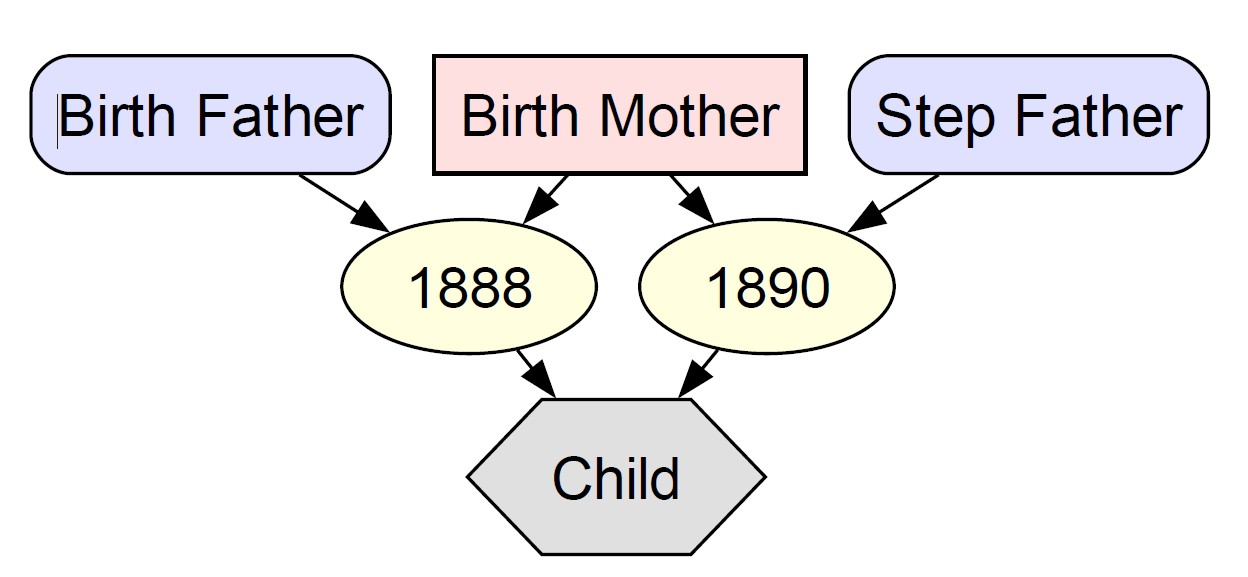
If all Parents are to be displayed in a single chart, the FamilyLines Graphical Report displays this. The ovals beneath the parents are the “Marriage” dates, if such dates are entered.